
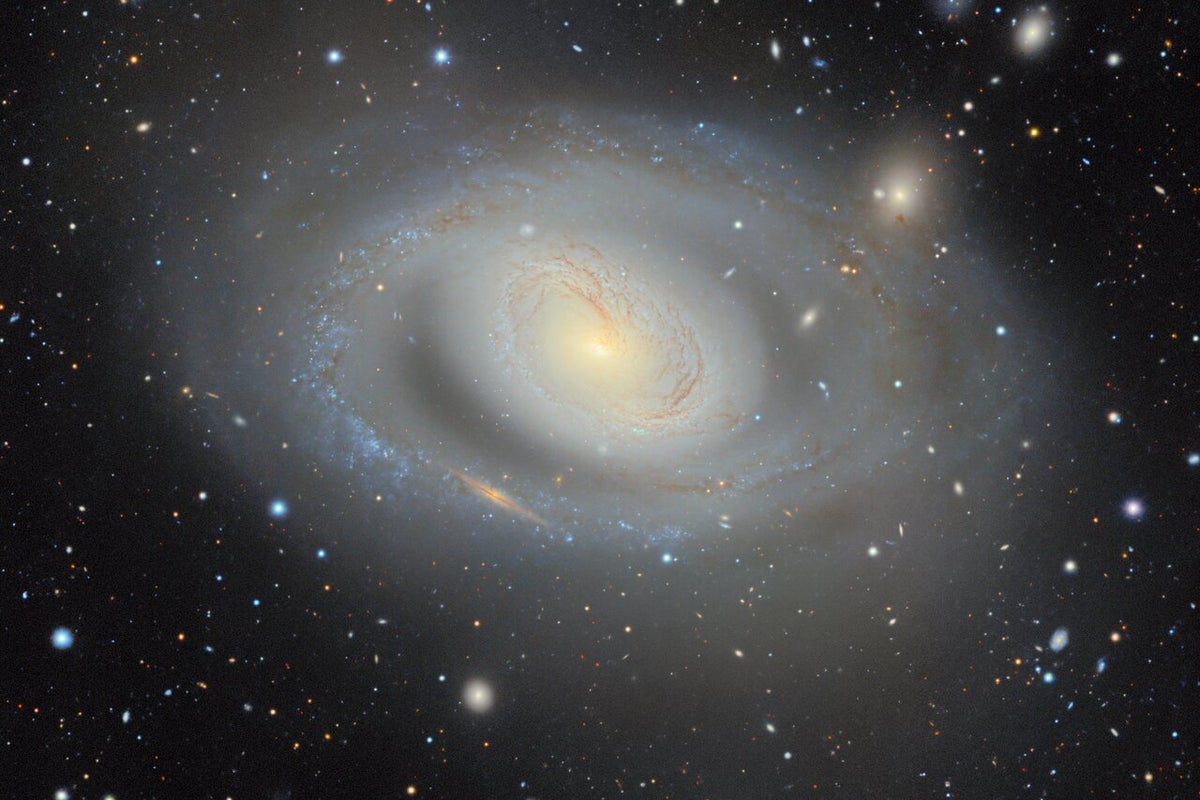
Astronomers Release Extensive New Two-Dimensional Map of the Universe
Researchers have published a comprehensive two-dimensional map cataloging nearly four billion celestial objects. The project provides a detailed overview of stars, galaxies, and supernovae across the observable sky.
A team of scientists has released what is being described as the largest two-dimensional map of the universe to date. The project, which aggregates data from various astronomical surveys, encompasses nearly four billion individual objects, including stars, galaxies, and supernovae. By flattening the vast, three-dimensional expanse of space into a two-dimensional representation, researchers aim to provide a clearer, more accessible overview of the distribution of matter in the cosmos.
This map serves as a significant resource for the scientific community, allowing astronomers to better visualize the structure of the universe and identify patterns in the placement of celestial bodies. While the map is two-dimensional, it incorporates data collected over several years of observation, utilizing high-resolution imaging to ensure accuracy across the vast catalog of objects. The release is intended to assist in future research, providing a foundational reference for those studying galactic evolution and the expansion of the universe. Because the data set is so extensive, it covers a significant portion of the sky, offering a panoramic view that was previously difficult to synthesize into a single, cohesive document.
📡 Media Analysis
How each outlet framed the story — angles, word choices, and what they chose to push or ignore.
Focused on the scale and scientific achievement of the mapping project.
"biggest two-dimensional map"
🔍 What Nobody's Reporting
- ·Lack of information regarding the specific technology or telescope arrays used to compile the data.
- ·No mention of the potential limitations or margins of error inherent in a two-dimensional projection of a three-dimensional universe.
📰 Sources
0 A-rated source(s) among 1 total. Lowest trust: The Independent (B)