
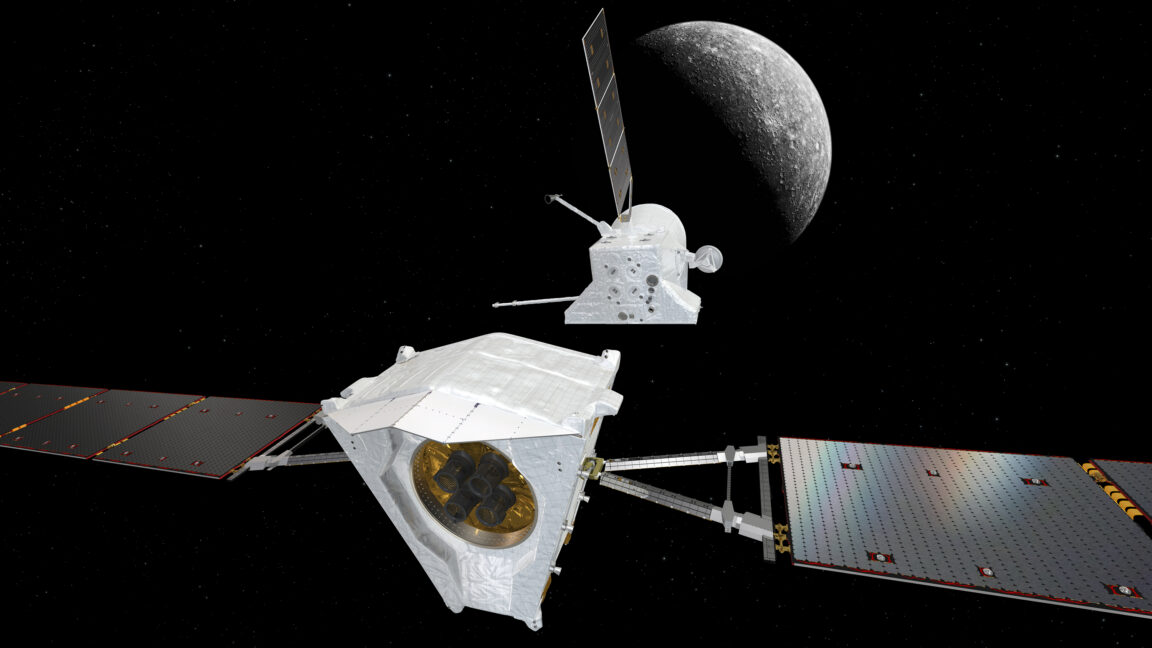
BepiColombo Mission Nears Mercury After Eight-Year Journey
The European Space Agency's BepiColombo mission is entering its final approach phase to Mercury. The mission aims to investigate the planet's origins and geological evolution.
After an eight-year journey through the solar system, the BepiColombo spacecraft is reaching the final stages of its mission to Mercury. The joint project between the European Space Agency (ESA) and the Japan Aerospace Exploration Agency (JAXA) is designed to conduct a comprehensive study of the planet, which remains one of the least explored bodies in the inner solar system.
The spacecraft is currently navigating a complex series of gravity-assist maneuvers, utilizing the gravitational pull of Earth, Venus, and Mercury itself to slow down and enter the planet's orbit. This method is necessary because the intense gravitational pull of the Sun makes reaching Mercury's orbit technically challenging. Once the spacecraft arrives, it will separate into two distinct orbiters: the Mercury Planetary Orbiter and the Mercury Magnetospheric Orbiter. These instruments will work in tandem to map the planet’s surface, analyze its composition, and study its magnetic field.
Scientists involved in the mission emphasize that the primary goal is to understand how Mercury formed and why its current environment differs so significantly from other terrestrial planets. By examining the planet's internal structure and surface features, researchers hope to gain insight into the early history of our solar system. The mission is expected to provide data that could explain the planet's high density and the nature of its thin atmosphere. As the spacecraft completes its final approach, mission controllers are monitoring the systems to ensure the transition into Mercury's orbit proceeds as planned, marking the culmination of nearly a decade of flight time.
📡 Media Analysis
How each outlet framed the story — angles, word choices, and what they chose to push or ignore.
Focused on the scientific purpose and the long-term timeline of the mission.
"final approach"
🔍 What Nobody's Reporting
- ·Specific technical challenges or risks associated with the final orbital insertion maneuver.
- ·The current status of the two individual orbiters and their specific operational health.
📰 Sources
1 A-rated source(s) among 1 total. Lowest trust: Ars Technica (A)