
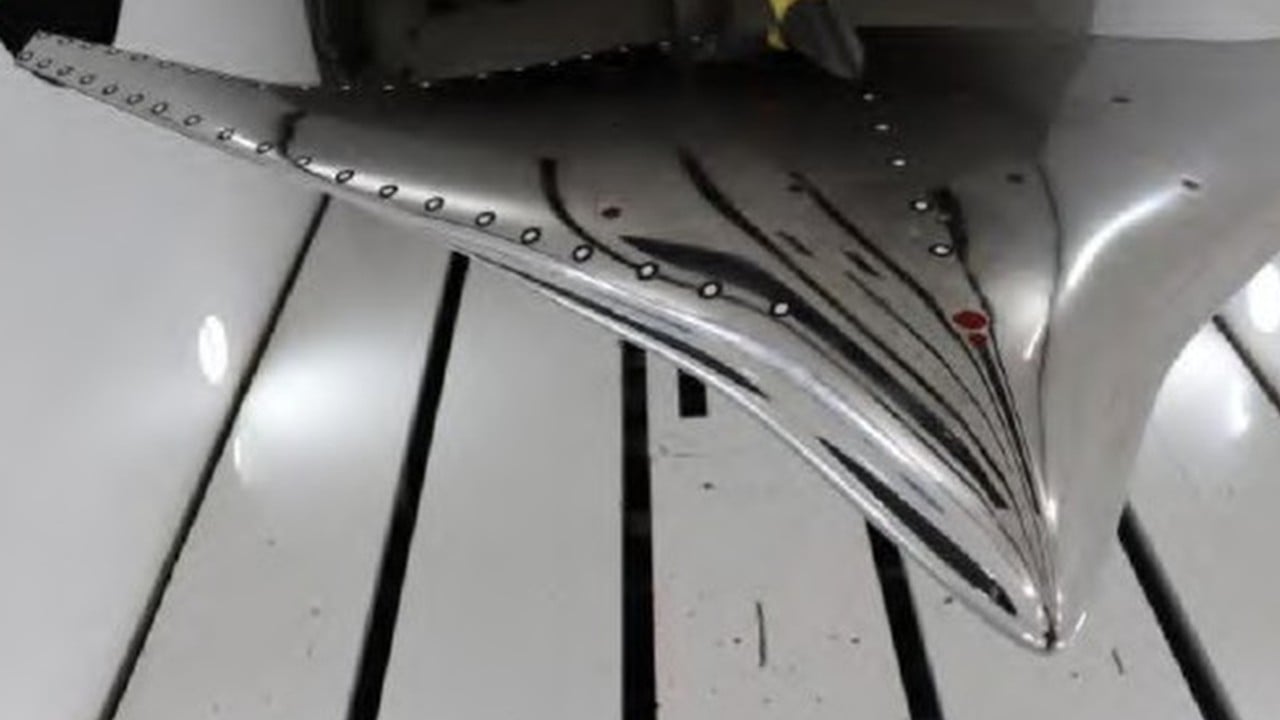
China Unveils Conceptual Design for 800-Passenger Flying Wing Aircraft
Chinese researchers have introduced an aerodynamic model for a large-scale 'flying wing' passenger jet capable of carrying over 800 passengers. The design integrates the fuselage and wings into a single structure to improve lift and efficiency.
A research team in China has publicly presented a conceptual model for a massive flying-wing aircraft designed for commercial passenger travel. Unlike traditional aircraft, which feature a distinct fuselage, wings, and tail assembly, the flying-wing design merges these components into a single, broad lifting body. This configuration is intended to maximize aerodynamic efficiency and internal volume.
The proposed aircraft is significant in scale, measuring 85 meters (280 feet) in width and 43 meters in length. According to the report, the wingspan of this conceptual jet is approximately 1.6 times that of the B-2 Spirit stealth bomber. While the project is currently in the conceptual and modeling phase, it represents a notable expansion of China’s broader national large aircraft development program.
Proponents of flying-wing designs generally argue that the shape provides superior lift-to-drag ratios compared to conventional tube-and-wing designs, potentially allowing for lower fuel consumption and increased passenger capacity. However, such designs face significant engineering hurdles, including challenges related to cabin pressurization, passenger evacuation, and the lack of windows for most passengers due to the depth of the wing structure. The SCMP report highlights the design as a bold entry into the global aerospace market, though it does not provide a specific timeline for when a prototype might be constructed or tested.
📡 Media Analysis
How each outlet framed the story — angles, word choices, and what they chose to push or ignore.
Focused on the technical ambition and scale of China's aerospace development program.
"bold new entry"
🔍 What Nobody's Reporting
- ·Lack of expert commentary on the feasibility of passenger safety and evacuation in a flying-wing configuration.
- ·Absence of information regarding the propulsion systems required to power an aircraft of this size.
📰 Sources
0 A-rated source(s) among 1 total. Lowest trust: SCMP (B)