
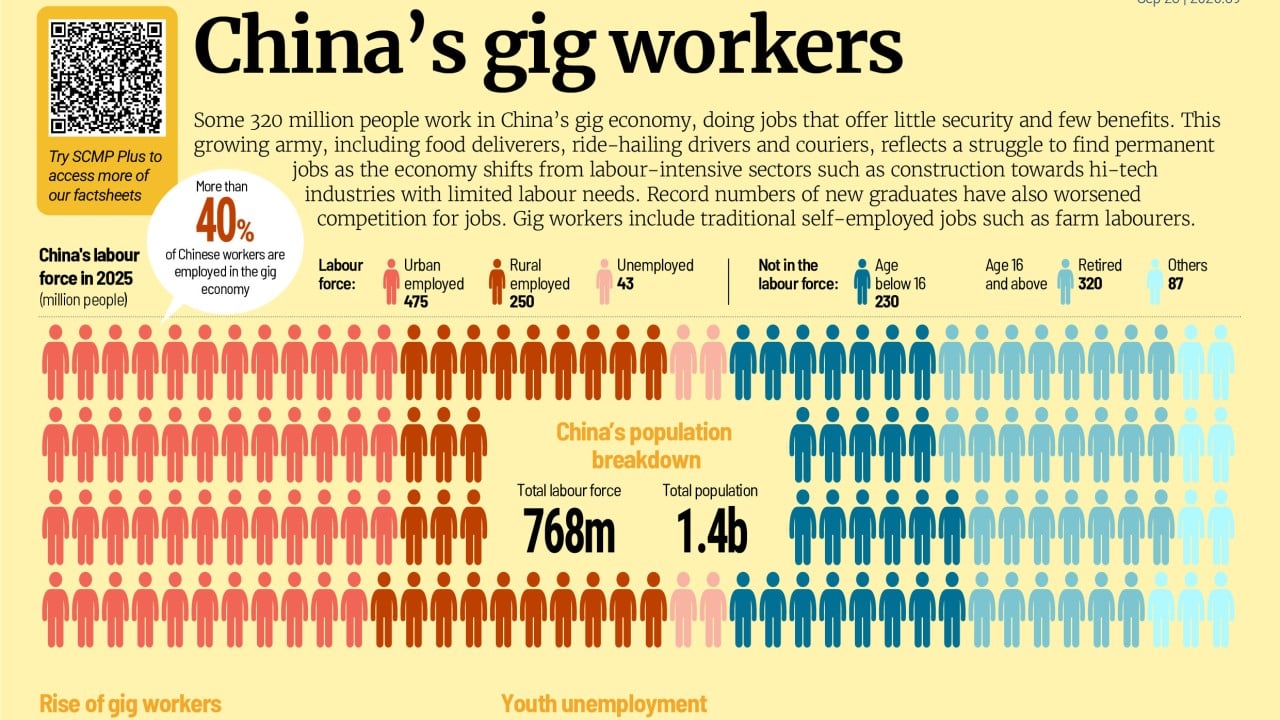
China's Gig Economy Faces Regulatory and Structural Challenges
China's gig economy has grown rapidly, providing employment for millions of workers in delivery, ride-hailing, and freelance sectors. However, the sector is currently navigating significant regulatory scrutiny and concerns regarding worker protections and long-term economic sustainability.
Market Narrative Detected
The narrative suggests that China's gig economy is transitioning from a 'wild west' growth phase to a state-managed model, benefiting the government by stabilizing labor unrest while potentially squeezing the margins of private tech companies.
The gig economy in China has become a critical pillar of the nation's labor market, absorbing a significant portion of the workforce amid broader economic shifts. Platforms in sectors like food delivery and ride-hailing have scaled rapidly, offering flexible entry points for workers. However, this growth has prompted the Chinese government to introduce new regulations aimed at improving labor rights, including social security contributions and minimum pay standards for platform workers.
Analysts note that these regulatory changes are intended to address the 'precarity' of gig work, where workers often lack the benefits associated with traditional employment. While the government frames these interventions as essential for social stability and 'common prosperity,' industry observers point out that increased compliance costs could impact the profitability of major tech platforms. There is ongoing debate regarding the balance between protecting workers and maintaining the efficiency and low costs that have defined the sector's expansion. Furthermore, as China’s broader economy faces headwinds, the gig economy is increasingly viewed as a safety valve for unemployment, though its ability to provide long-term financial security remains a subject of intense discussion among economists.
📡 Media Analysis
How each outlet framed the story — angles, word choices, and what they chose to push or ignore.
Focused on the structural evolution of the gig sector within the context of China's unique regulatory environment.
"critical pillar"
🔍 What Nobody's Reporting
- ·Lack of specific data on how many gig workers have actually received improved benefits since the regulations were introduced.
- ·Absence of perspective from the gig workers themselves regarding their actual daily earnings versus platform claims.
📰 Sources
0 A-rated source(s) among 1 total. Lowest trust: SCMP (B)