
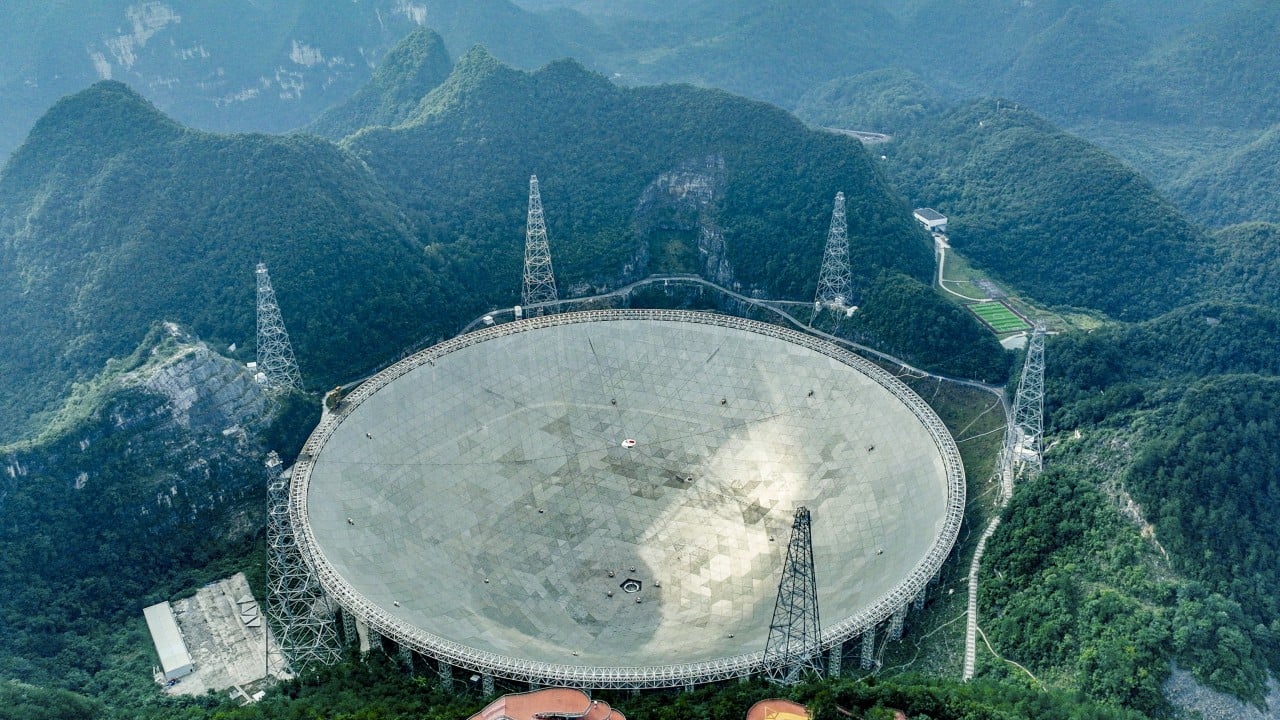
Chinese Astronomers Discover Stable Three-Star System Using FAST Telescope
Researchers using China's FAST radio telescope have identified a unique three-star system located 7,000 light-years from Earth. Unlike the chaotic system depicted in popular fiction, this configuration consists of two dead stars and one active star in a stable orbit.
Chinese astronomers have utilized the Five-hundred-meter Aperture Spherical Telescope (FAST) to observe a rare triple-star system. The system, situated approximately 7,000 light-years away, features a stable gravitational arrangement that contrasts with the unpredictable planetary conditions often associated with the 'three-body problem' in physics and science fiction.
The research team identified the components of the system as two stellar remnants and one active star. Specifically, one of the dead stars is a pulsar, which rotates at a high frequency of over 300 times per second. The stability of this system provides scientists with a new opportunity to study gravitational interactions in a real-world environment, as opposed to the theoretical or fictionalized versions that suggest such systems must be inherently chaotic.
While the discovery is significant for astrophysics, the report explicitly contrasts these findings with the work of author Liu Cixin. In his novel, *The Three-Body Problem*, the author depicts a world plagued by the erratic movements of three suns. The astronomers involved in this study note that the system they have observed is 'better behaved' than the fictionalized version, demonstrating that three-body systems can maintain long-term orbital equilibrium.
📡 Media Analysis
How each outlet framed the story — angles, word choices, and what they chose to push or ignore.
Used a popular science fiction reference to make complex astrophysics more accessible to a general audience.
"better behaved"
✓ Only outlet to report: The specific detail that the pulsar spins more than 300 times per second.
🔍 What Nobody's Reporting
- ·Lack of peer-reviewed context or confirmation from independent international observatories.
- ·No explanation of the specific gravitational mechanics that allow this system to remain stable.
📰 Sources
0 A-rated source(s) among 1 total. Lowest trust: SCMP (B)