
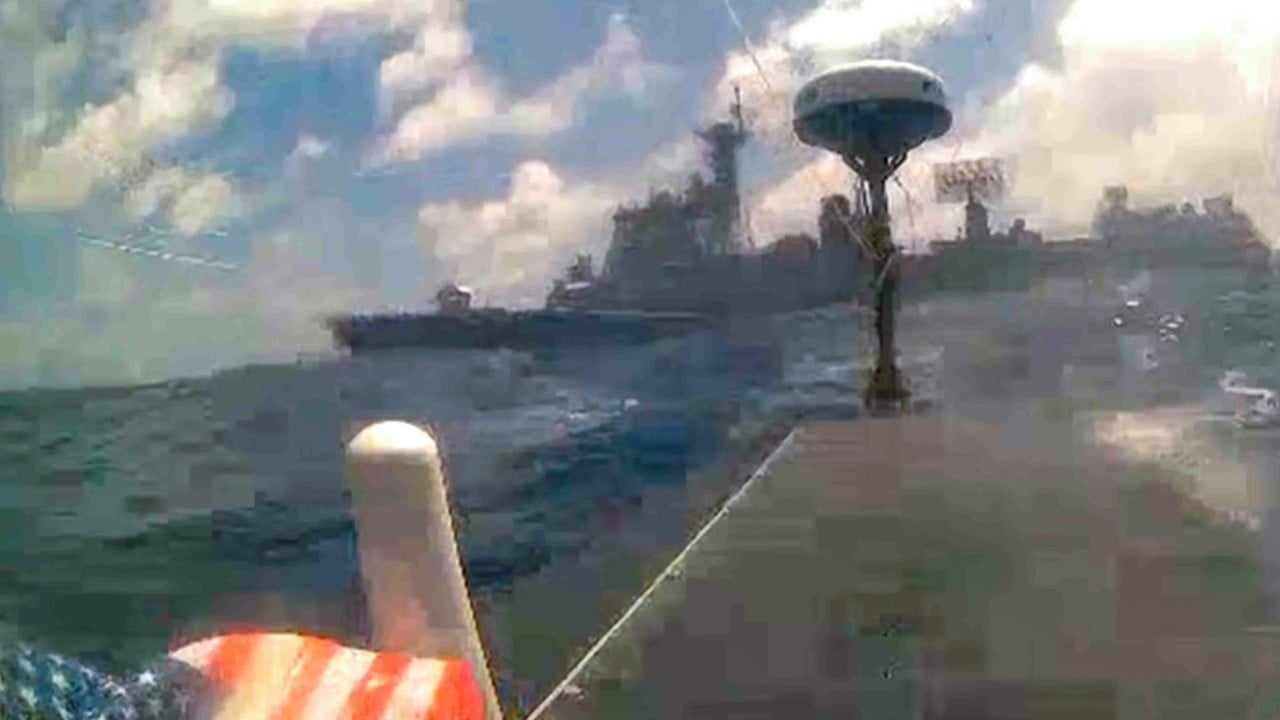
Commercial autonomous sea drones observed monitoring Chinese warships in South China Sea
California-based company Seasats recently released verified footage of its 'Lightfish' drone operating near a Chinese guided-missile destroyer. The incident highlights the growing use of low-cost commercial technology to track military movements in disputed maritime regions.
A new development in maritime surveillance has emerged as commercial autonomous sea drones are increasingly being used to monitor naval activity in the South China Sea. Last week, the California-based firm Seasats released footage showing its 'Lightfish' drone, a small autonomous vessel, operating in close proximity to a Chinese Type 052D guided-missile destroyer. The encounter reportedly occurred on June 16, approximately 105 kilometers northwest of Luzon in the Philippines.
This incident has prompted discussions among military analysts regarding the strategic implications of commercial technology in contested waters. While traditional naval surveillance relies on expensive, large-scale assets like satellites or manned aircraft, these small, relatively inexpensive drones offer a persistent and harder-to-detect method for tracking warships. The ability of private companies to capture and distribute such footage introduces a new layer of transparency—and potential friction—in the South China Sea and the Taiwan Strait.
There is currently no consensus on how the People’s Liberation Army (PLA) will respond to this trend. Some analysts suggest that the presence of these drones creates a 'headache' for Beijing by complicating their ability to conduct naval operations without being observed. Others note that because these vessels are commercial rather than state-owned, they exist in a legal gray area that makes them difficult to address through traditional diplomatic or military channels. While the footage has been verified by independent news organizations, the long-term impact of these drones on regional security remains a subject of ongoing debate.
📡 Media Analysis
How each outlet framed the story — angles, word choices, and what they chose to push or ignore.
Framed the technology as a disruptive nuisance for the Chinese military.
"new potential challenge"
✓ Only outlet to report: Reported the specific date (June 16) and location (105km northwest of Luzon) of the encounter.
🔍 What Nobody's Reporting
- ·Lack of comment or official response from the Chinese Ministry of National Defense.
- ·No information regarding the specific mission or operator of the drone at the time of the encounter.
📰 Sources
0 A-rated source(s) among 1 total. Lowest trust: SCMP (B)