
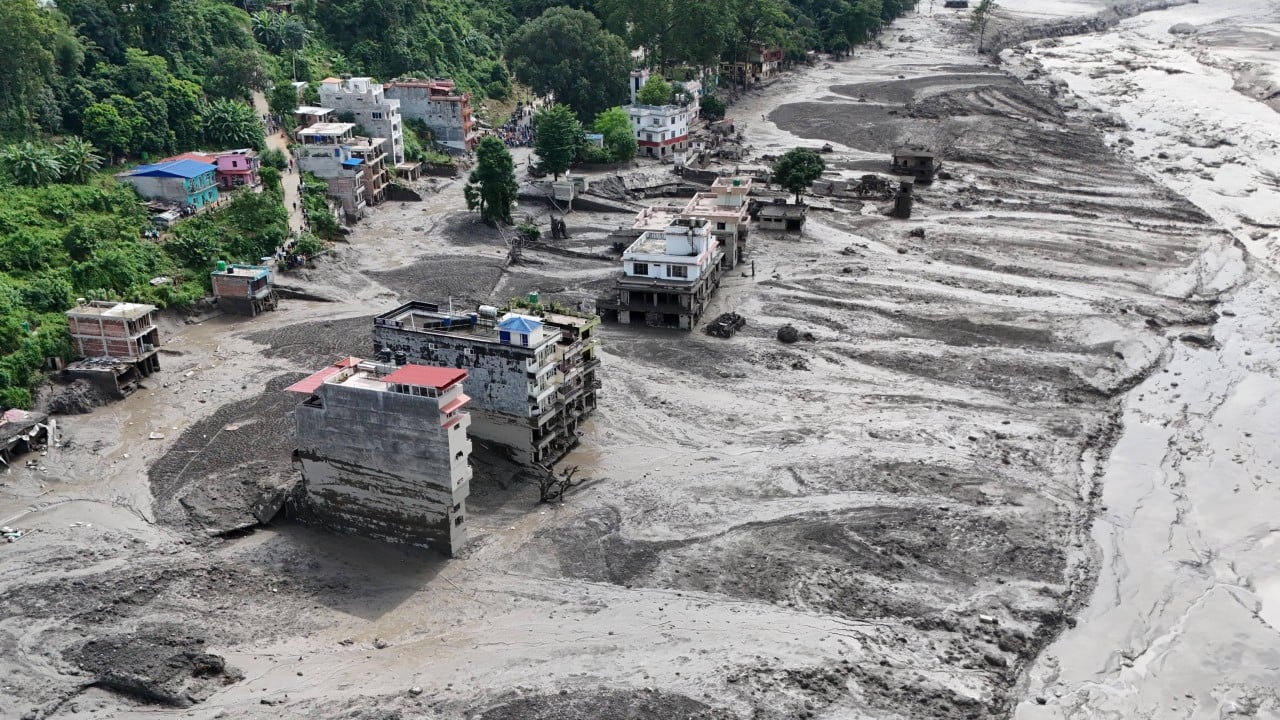
Flash floods and barrier lake collapse disrupt rescue efforts in Nepal
A glacier collapse in the Himalayas has triggered deadly flash floods and mudslides along the Nepal-China border. The resulting formation and subsequent bursting of a barrier lake have significantly hampered ongoing search and rescue operations.
A series of catastrophic flash floods and mudslides, initiated by a glacier collapse on the Nepal side of the Himalayan range, has resulted in at least 547 deaths, according to reports. The disaster has led to the formation of a 'barrier lake'—a body of water created when landslide debris dams a river—which burst its banks on Friday. This development has forced authorities to halt rescue operations in the immediate border region.
While the human toll continues to rise, with hundreds still reported missing, the scale of the response is significant. NDTV reports that approximately 14,000 security personnel have been deployed to the affected areas, successfully rescuing over 3,700 people, including 85 Indian nationals.
There is a notable divide in how the event is being contextualized. While Al Jazeera focuses on the immediate environmental mechanics and the resulting operational paralysis, the South China Morning Post (SCMP) highlights the geopolitical fallout of the disaster. SCMP reports that the initial uncertainty surrounding the cause of the floods led to a surge of misinformation on social media, with some users incorrectly blaming Chinese-built infrastructure for the catastrophe. Scientists cited by SCMP maintain that the event was a natural geological occurrence caused by the glacier collapse, rather than a man-made failure. The sources agree on the physical cause of the disaster but diverge significantly on whether the event should be viewed primarily as a humanitarian crisis or a focal point for regional information warfare.
📡 Media Analysis
How each outlet framed the story — angles, word choices, and what they chose to push or ignore.
Focused strictly on the immediate physical danger and the logistical impact on rescue teams.
"barrier lake"
Prioritized the human casualty count and the scale of the government-led rescue response.
"547 Killed"
✓ Only outlet to report: Specific count of Indian nationals rescued.
Framed the disaster through the lens of regional geopolitics and the spread of anti-China sentiment.
"wave of anti-China misinformation"
✓ Only outlet to report: Detailed the social media misinformation campaign blaming Chinese infrastructure.
⚡ Where Sources Disagree
- ·The extent to which the disaster is being used as a proxy for geopolitical tension versus being treated as a purely humanitarian event.
🔍 What Nobody's Reporting
- ·Lack of information regarding the long-term environmental stability of the region following the glacier collapse.
- ·Limited details on the specific conditions of the missing persons or the status of the displaced population.
📰 Sources
0 A-rated source(s) among 4 total. Lowest trust: Al Jazeera (B)