
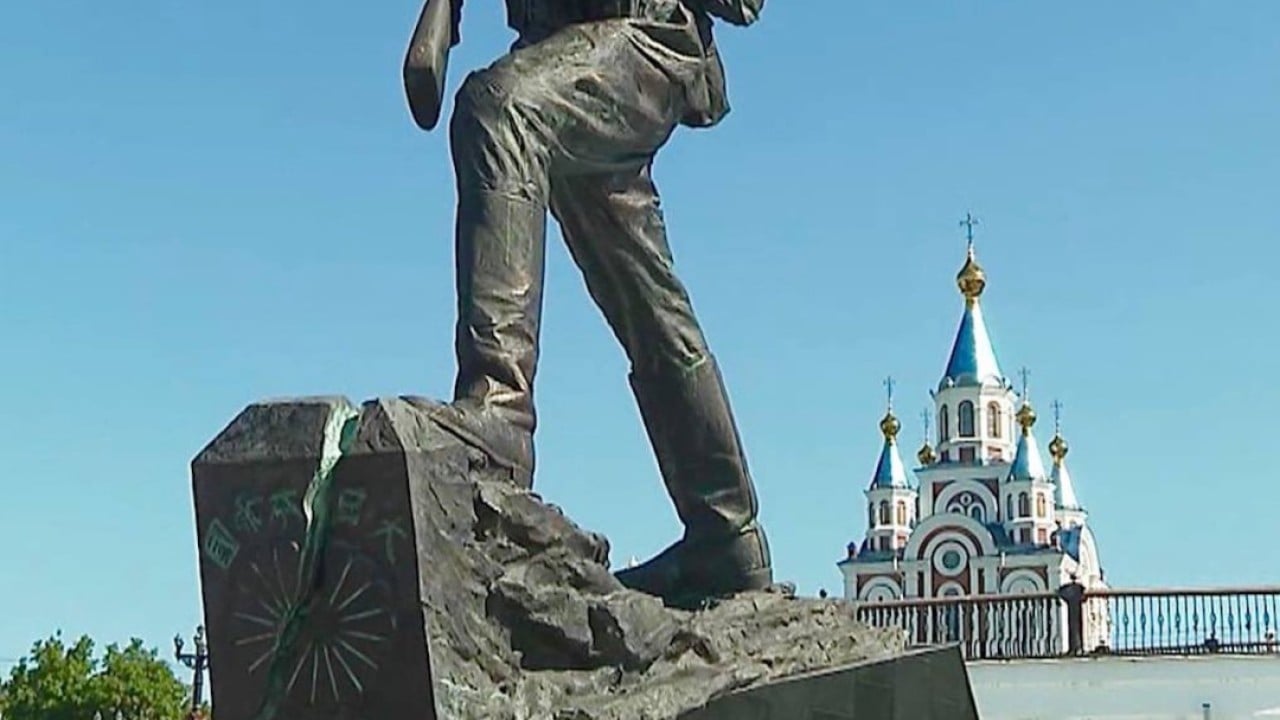
Japan Protests New Russian Statue Depicting Defeat of Imperial Forces
The Japanese government has formally complained to Russia regarding a new 15-meter monument in Khabarovsk that depicts a Soviet soldier destroying a Japanese imperial border marker. Russia has rejected the protest, further straining diplomatic relations between the two nations.
Tensions between Tokyo and Moscow have escalated following the unveiling of a granite monument in the Russian city of Khabarovsk. The statue commemorates the Soviet Union’s 1945 military victory over Japan and features a soldier using a rifle to shatter a border marker bearing the emblem of the Japanese emperor. The monument is modeled after historical border posts that existed during the era of the Japanese Empire.
Japan issued a formal, strongly worded complaint regarding the installation, viewing the imagery as provocative. In response, Russian officials have rebuffed the protest, maintaining their right to commemorate historical military achievements. Analysts suggest that this incident is part of a broader 'summer of tension' between the two countries, noting that bilateral relations are unlikely to improve in the near future. While the monument serves as a point of national pride for Russia, it is perceived in Japan as an aggressive symbol that undermines efforts to maintain diplomatic decorum. The disagreement highlights the ongoing difficulty in reconciling historical narratives between the two nations, particularly regarding the events of World War II and the subsequent territorial disputes that have persisted for decades.
📡 Media Analysis
How each outlet framed the story — angles, word choices, and what they chose to push or ignore.
Framed the statue as a deliberate provocation contributing to a larger pattern of regional diplomatic friction.
"aggravates ‘summer of tension’"
✓ Only outlet to report: Identified the specific location of the statue in Khabarovsk and the physical dimensions of the monument.
⚡ Where Sources Disagree
- ·Whether the statue is a legitimate historical commemoration (Russian view) or an act of diplomatic provocation (Japanese view).
🔍 What Nobody's Reporting
- ·Lack of comment or official statement from the Russian Ministry of Foreign Affairs regarding the specific reasoning for the statue's placement.
- ·Absence of historical context regarding the specific border markers depicted in the statue.
📰 Sources
0 A-rated source(s) among 1 total. Lowest trust: SCMP (B)