
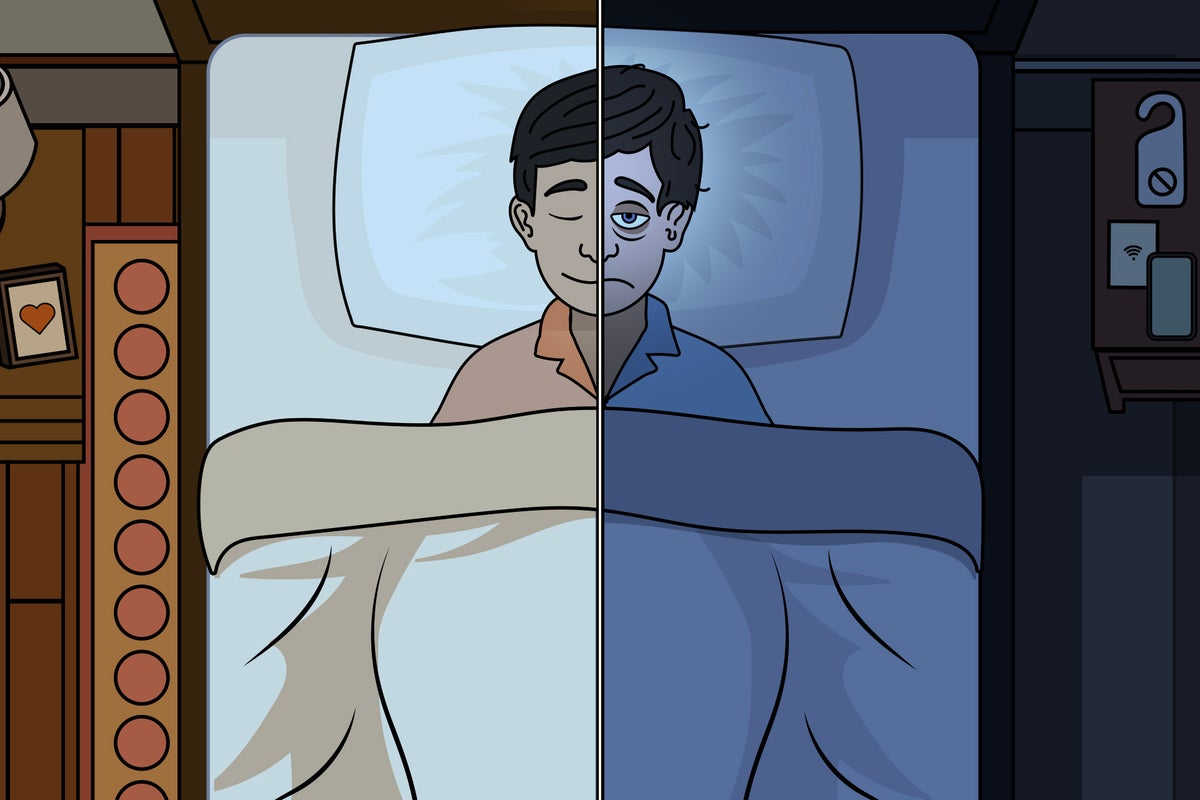
Researchers identify why sleeping in new environments often leads to poor rest
A phenomenon known as the 'first-night effect' causes one hemisphere of the brain to remain more alert when sleeping in an unfamiliar location. This evolutionary trait likely serves as a protective mechanism to monitor for potential threats in unknown surroundings.
Many people experience difficulty falling asleep or staying asleep when spending their first night in a new environment, such as a hotel or a friend's home. Scientists refer to this as the 'first-night effect.' Research suggests that this is not merely a psychological reaction to discomfort, but a physiological state where the brain remains partially vigilant.
Studies using neuroimaging have shown that during the first night in a new location, the left hemisphere of the brain exhibits reduced 'slow-wave' activity compared to the right hemisphere. Slow-wave activity is associated with deep, restorative sleep. By keeping one side of the brain more active, the body appears to be maintaining a heightened state of awareness, effectively acting as a 'night watchman' to detect unusual sounds or potential dangers in an unfamiliar setting.
While this mechanism likely provided an evolutionary advantage for ancestors who needed to remain alert to predators in new territories, it is often counterproductive in modern life. The brain’s inability to fully 'switch off' in a new bed leads to fragmented sleep and morning grogginess. Experts note that this effect typically diminishes after the first night, as the brain becomes accustomed to the new environment and deems it safe, allowing both hemispheres to enter deep sleep cycles more easily. While the biological basis for this phenomenon is well-documented, researchers continue to study how individual differences in sensitivity to new environments might affect the severity of the first-night effect.
📡 Media Analysis
How each outlet framed the story — angles, word choices, and what they chose to push or ignore.
Explained the biological mechanism behind a common human experience in accessible terms.
"stays awake"
🔍 What Nobody's Reporting
- ·Lack of discussion on practical strategies to mitigate the first-night effect.
- ·No mention of whether this effect varies significantly across different age groups.
📰 Sources
0 A-rated source(s) among 1 total. Lowest trust: The Independent (B)